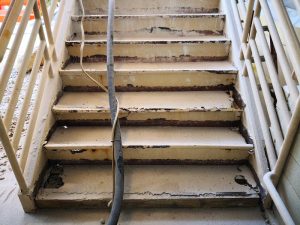

Why does paint peel off metal? Nine times out of ten in Gainesville, it is not the paint’s fault. It is what was under the paint when somebody sprayed it. A gate on a Newberry Road property, a trailer frame parked out in Alachua, a stair rail at a student complex off Archer Road — they all peel for the same handful of reasons, and every one of them traces back to prep.

Here is the honest part most people skip: paint is not glue. It does not grab a surface by wanting to. It grabs mechanically, into a roughened profile, and chemically, to clean bare steel. Take either of those away and the coating is just a skin sitting on top, waiting on the first hot Alachua County afternoon to let go.
Why Does Paint Peel Off Metal? The Six Real Causes
1. It was painted over rust
This is the big one. Somebody wire-brushed the loose scale off, saw gray metal in a few spots, and rolled on primer. The trouble is rust is not a stain — it is a growing layer. Leave any of it and it keeps pulling moisture under the film, expanding as it goes, and lifting the coating from underneath like a blister. You will see it first at welds and edges, then it spreads in sheets.
Rust-converting primers get sold hard for this. They have a place on light surface rust in a dry climate. In Florida humidity, on pitted steel, they buy you a season or two at best. If the metal matters, the rust comes off — all of it — down to clean steel.
2. Mill scale was never removed
New steel comes from the mill with a thin blue-gray layer of iron oxide fused to it, called mill scale. It looks like a finish. It feels solid. It is not bonded to the steel underneath in any way you can count on. Paint mill scale and you have painted a sheet of shingles that are about to slide off. A year later the coating peels in big flat flakes with the scale still stuck to the back of them. That is the tell.
This is why new fabricated steel — a handrail, a gate, a fresh trailer frame — still needs blasting before it is coated. Blasting is what takes that scale off. Nothing you can do with a sander does it evenly.
3. There was no profile for the paint to bite into
Sand a piece of steel glass-smooth and paint will not hold on it. Coatings need texture — a measured roughness the trade calls surface profile, usually somewhere around 1.5 to 3 mils of peak-to-valley depth depending on what is going over it. Abrasive blasting creates that profile while it cleans. That is the whole reason blasting beats grinding for prep: you get cleanliness and anchor pattern in one pass.
If a coating is peeling off in sheets that come away clean on the back, with shiny metal underneath and no rust at all, that is a profile problem. The paint never had anything to grip.
4. Soluble salts and contamination stayed on the surface
Chlorides and sulfates are invisible. You cannot see them, and washing with a hose does not take them off. They are common on anything that has been near the coast, near a road that gets treated, or near livestock and fertilizer — which covers a lot of Alachua County farm equipment. Trap salts under a coating and they pull moisture straight through the film by osmosis. The result is small round blisters that look like the paint has chicken pox.
Oil, grease, and silicone do their own version of this. Blast over them and you just drive the contamination into the profile. Degreasing comes first, always, then blasting. That order is not optional.
5. It was coated in the wrong weather — or too late
Two ways this goes wrong here. Paint over a surface that is below the dew point and you are painting over a film of condensation you cannot see. Or blast clean steel, break for lunch, and come back to find a light orange bloom already on it. That is flash rust, and in Gainesville in July it can start inside of an hour. Coat over it and you have built the failure in on day one.
Our answer to that is simple: we blast and coat with the same crew on the same day, and we watch the dew point before anybody opens a can. Not because it sounds impressive — because the alternative is coming back in eighteen months.
6. The wrong coating for the exposure
Not everything that peels was prepped badly. Sometimes the prep was fine and somebody put an interior-grade enamel on a gate that takes full west sun and summer storms. UV chalks it, water gets in at a chip, and it undercuts from there. A trailer frame that lives on Florida roads wants a different system than a shop rack that never leaves the building. Match the coating to what the metal is actually going to live through.
How to Tell Which One You Are Looking At
Pop a peeling flake off with a putty knife and turn it over. That back side tells you nearly everything:
- Rust stuck to the back, pitted metal underneath — painted over rust.
- A hard blue-gray layer on the back, big flat sheets — mill scale.
- Clean, shiny, smooth metal underneath — no profile.
- Small round blisters, sometimes with moisture inside — soluble salts or contamination.
- Chalky, faded topcoat that rubs off on your hand — wrong coating for the sun exposure.
It is worth doing before you call anybody. If you know why it failed, you will know whether the fix is a spot repair or a full strip.
When You Should Not Bother Calling Us
We will say this plainly. If it is a small patio table, a mailbox post, or one section of shelving, and the rust is light surface bloom, a wire wheel on a drill and a can of quality direct-to-metal paint on a dry day will get you a few honest years. That is not a job that needs a blast rig and a trailer in your driveway. If a Saturday will do it, we will tell you.
Where blasting earns its keep is when the metal is worth keeping and the failure is structural: pitted farm equipment, a trailer frame, ornamental iron with detail you cannot sand into, a commercial stair or rail with a liability attached to it, or anything where the coating has to last. Then you want every bit of rust, scale, and salt gone and a real profile cut into the steel before primer touches it.
What Proper Prep Actually Looks Like
The industry does not leave this to opinion. SSPC and NACE wrote it down — SP 6 commercial blast, SP 10 near-white, SP 5 white metal — each one defining exactly how much staining is allowed to remain on the surface. Most of what we do around Alachua County is SP 6 or SP 10, and we tell you which one the job is getting and why. You can read the standards yourself at SSPC, and OSHA publishes the worker-safety side of abrasive blasting at osha.gov/abrasive-blasting.
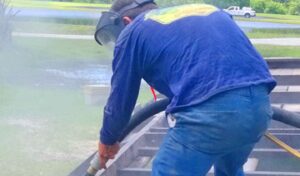
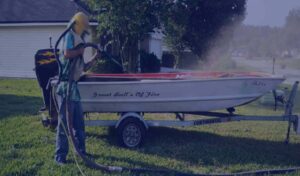
On our end the sequence does not change: degrease, contain the site, blast to the specified standard with media matched to the metal, check the profile, and coat before flash rust has a chance to start. Thin sheet metal gets a softer media and a lower pressure so it does not warp. Ornamental iron gets a finer abrasive so the detail survives. We pick by the job, never by what is cheapest in the hopper.
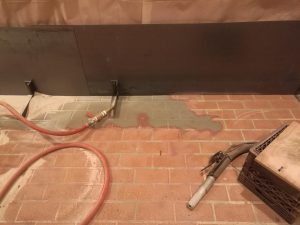
If your project is structural steel, equipment, or ornamental work, that is metal sandblasting in Gainesville. If dust control is the concern — an occupied building, a neighbor close by, a vehicle nearby — dustless blasting in Gainesville knocks the airborne dust down considerably, with the trade-off that you get a wet, muddy mess to clean up and a surface you have to treat before coating. And once the metal is clean, our painting and coating services put the system back on the same day, with the same crew that did the blasting.
The Short Answer
Paint peels off metal because it was asked to stick to something that was never ready for it — rust, mill scale, a glass-smooth surface, invisible salt, or condensation. Fix the prep and the same can of paint that failed in a year will go five or ten. Skip the prep and it does not matter what you spray.
Need sandblasting in Gainesville or nearby? Call (352) 663-1129 for a free on-site estimate. You will reach someone who actually does the work.