Lead paint removal in Florida comes with rules, real health stakes, and a lot of confusion — especially for owners of older homes around Gainesville, Micanopy, High Springs, and the historic neighborhoods of North Central Florida. If your building went up before 1978, this guide is for you: how to find out whether lead paint is actually present, what federal rules govern its removal, which methods are safe and which are flatly prohibited, and — because honesty is policy here — exactly what we do and do not take on when lead is involved.
Why Lead Paint Is Treated Differently
Lead-based paint was common in American housing until the federal government banned it for residential use in 1978. Intact, well-maintained lead paint is largely a managed risk. The danger is dust: when lead paint is sanded, scraped, blasted dry, or burned, it releases fine particles that settle into soil and floors and stay there. Lead is a potent neurotoxin with no safe blood level in children — small exposures affect development permanently — and it harms adults too, which is why removal is regulated rather than merely recommended. The age of the building is the trigger: anything pre-1978 is presumed to contain lead paint somewhere until testing says otherwise.
First Step: Find Out If You Actually Have It
Do not assume — test. Options run from EPA-recognized instant test kits at hardware stores (fine for a quick read on a railing or door frame) up to a certified lead inspector with an XRF analyzer who can map an entire building without destructive sampling. Testing matters in both directions: it can free a 1960s house from needless cost when the old paint turns out to be lead-free, and it can flag the one porch railing on a 1990s property that was painted with leftover stock. Test the layers, not just the top coat — lead is usually buried under newer paint.
The Rules: EPA Renovation, Repair and Painting (RRP)
Federal law governs disturbing lead paint in housing and child-occupied facilities built before 1978. Under the EPA RRP program, contractors disturbing more than minor amounts of painted surface in such buildings must be EPA-certified firms using certified renovators, following lead-safe work practices: containment, wet methods, HEPA cleanup, and proper disposal. RRP also prohibits the most dangerous practices outright — open-flame burning, heat guns above 1,100°F, and power sanding, grinding, or abrasive blasting without HEPA-rated containment. Florida follows the federal EPA program. The practical translation: dry, uncontained blasting of lead paint on a pre-1978 house is not a gray area — it is exactly what the rule exists to prevent.
What Safe Removal Looks Like
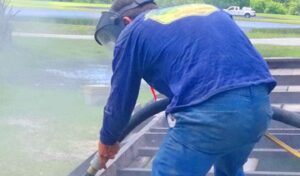
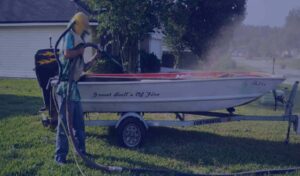
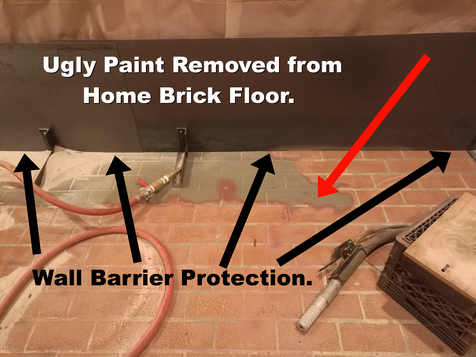
Lead-safe work shares one principle: keep the dust down and capture what is made. That means wet methods — misting before scraping, wet sanding, or water-injected blasting that suppresses dust at the point of impact — plus plastic containment, HEPA vacuums rather than shop vacs, and bagging waste instead of letting it weather into the yard. It also means restraint: sometimes the lead-safe answer is stabilization — encapsulating sound lead paint under a specialized coating — rather than full removal. A certified renovator or abatement firm weighs that call. Dust suppression is the same engineering that drives our dustless blasting on ordinary projects; with lead, the difference is the certification, containment, and verification wrapped around it.
The Homeowner Exemption — and Its Limits
Federal rules include a notable carve-out: owner-occupants doing work on their own residence are generally exempt from RRP certification requirements (rules differ for rentals, pre-1978 child-occupied facilities, and when others live in the home — check before relying on this). Exempt does not mean safe: the dust harms your own family first, so the same wet methods, containment, and HEPA cleanup apply whether or not an inspector is watching. Some equipped homeowners take this path for small, manageable areas; whole-house lead projects are professional territory by any honest measure.
Our Honest Policy on Lead Work
Gainesville Sandblasting does not perform lead paint abatement. Certified lead work carries regulatory and verification requirements that belong with dedicated, certified abatement firms, and pretending otherwise would not serve you. Here is how we actually help. If your building is pre-1978, we ask about it up front and recommend testing before any blasting is scheduled. If testing confirms lead, we will point you toward certified professionals — or, for owner-occupants handling small projects under the homeowner exemption, we have historically offered equipment rental with training on safe operation, breathing protection, and cleanup, which can save a homeowner significant cost on a project they are legally permitted to do themselves. And when testing comes back clean, we get on with the restoration: wood, brick, metal, or concrete, with coating services right behind it.
Lead Paint FAQs
My house was built in 1985 — am I in the clear? For the original paint, almost certainly yes. The 1978 ban is the line; post-1978 construction is outside RRP scope.
Can lead paint just be painted over? Sound, intact lead paint can often be stabilized or encapsulated — a legitimate managed approach. Peeling, chalking, or friction surfaces (windows, doors, stair treads) need proper attention first.
Does dustless blasting make lead removal legal? Dust suppression is necessary but not sufficient — on covered pre-1978 projects, certification, containment, and cleanup verification are required regardless of method.
Who do I call for testing near Gainesville? Search for a Florida-licensed lead inspector or risk assessor; the EPA locator lists certified firms by area. Test first — every good decision downstream depends on it.
Where Lead Hides in North Central Florida Properties
Around Gainesville, the pre-1978 housing stock concentrates in a few familiar places: the historic districts near downtown and the university, the older blocks of Micanopy, High Springs, Hawthorne, and Waldo, mid-century ranch neighborhoods, and farm structures — barns, outbuildings, and metal equipment painted decades ago with industrial lead coatings. On houses, the highest-risk surfaces are the ones that rub or weather: window sashes and sills, door jambs, porch floors and railings, stair components, and exterior siding with layered repaints. On farms, old machinery and steel are common carriers — worth remembering before anyone takes a grinder to a vintage tractor. Soil near old exterior walls can also hold decades of paint dust, which matters for gardens and play areas. None of this is cause for panic; intact paint, managed sensibly, is a known quantity. It is cause for testing before any project that will disturb old layers — sanding, scraping, blasting, even aggressive pressure washing — because the rules and the right method both hinge on what that test says. Budget the test as part of the project: it is a small line item that protects your family and keeps the whole job on the right side of the law.
A Sensible Path for Pre-1978 Owners
Pulling the threads together, the safe sequence for an older property is short. Start with the year built — county property records settle it in a minute. If it is pre-1978 and the project will disturb paint, test before anything else; the result decides everything downstream. Lead present and the area is small and you live there? The homeowner exemption may apply — work wet, contain, clean with HEPA, and dispose properly, with rented professional equipment and training if that helps. Lead present and the project is large, a rental, or simply more than you want to own? Bring in a certified abatement firm and let the verification paperwork protect you. No lead? Proceed like any restoration — and enjoy knowing for certain. The one move with no defenders is the common one: skipping the test and sanding or dry-blasting old paint on faith. The test costs little. The dust, once made, cannot be unmade — and it settles where your family lives. Old houses around Gainesville are worth restoring; this is just the order that lets you restore them safely.
Need sandblasting in Gainesville or nearby? Call 352-663-1129 for a free on-site estimate.