Industrial equipment sandblasting is maintenance that pays for itself — when it happens at the right time. Machinery, structural steel, tanks, trailers, and agricultural equipment all fight the same two enemies in Florida: corrosion that never sleeps in our humidity, and buildup — concrete, asphalt, feed, fertilizer, grime — that hardens onto working surfaces. This guide covers when equipment genuinely needs blasting, why it beats the alternatives on industrial surfaces, how coating systems and standards fit in, and how working operations schedule the work without surrendering uptime.
What Counts as Industrial Equipment Work
The category is broader than factory machinery. Around Gainesville and North Central Florida it includes construction equipment and attachments, cranes and lifting gear, agricultural machinery and implements, utility and livestock trailers, tanks and hoppers, structural steel and mezzanines, conveyor frames, racking, fencing and gates at commercial sites, and the steel stairways and platforms that hold facilities together. The common threads: steel that works for a living, coatings that protect real asset value, and downtime that costs money.
When Equipment Actually Needs Blasting
Corrosion past the cosmetic stage. Surface rust on steel becomes scale, scale becomes pitting, and pitting becomes section loss. The moment rust flakes or paint blisters, the coating system has failed and recoating without full removal just buries an active problem.
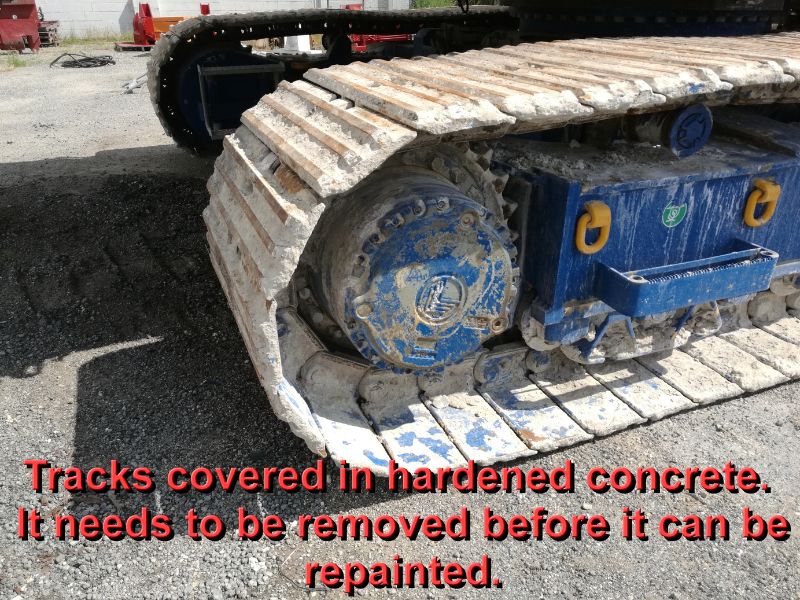
Hardened buildup interfering with function. Concrete on mixer frames and crane undercarriages, asphalt on paving gear, packed material on agricultural implements — buildup adds weight, hides damage, jams moving parts, and defeats inspection. Our industrial crane project is a textbook case: hardened concrete stripped from running gear with media chosen to protect machined tolerances.
Before recoating or rebranding. Any serious coating system specifies surface cleanliness and profile. Painting over chalked, failing coatings wastes the paint; blasting to spec first is what makes the new system last.
Before inspection, sale, or certification. Clean steel can be inspected, measured, and valued. Buildup and rust hide cracks, welds, and thinning that inspectors and buyers will assume are worse than they are.
Why Blasting Beats the Alternatives on Industrial Steel
Grinding and needle-scaling work for spots, but on whole machines they are slow, miss recesses, and risk gouging machined surfaces. Chemical stripping at equipment scale means gallons of product, runoff control, and stubborn results on thick industrial coatings. High-pressure water alone removes loose material but leaves bonded coatings and flash-rusts bare steel without inhibitors. Abrasive blasting does what none of the others can: strips coatings, rust, and buildup together, reaches recesses and weldments, leaves the exact profile the next coating needs, and scales from a single trailer to a fleet. Media selection is the control knob — aggressive grit for structural members, finer media around machined fits, exactly the judgment our metal sandblasting service applies machine by machine, with media types matched to each surface.
Coating Systems and Standards
Industrial recoating is specification work. Data sheets name an SSPC cleanliness level — typically commercial blast (SP-6) for normal atmospheric service, near-white (SP-10) for harsh exposure — plus a profile depth the primer needs; our SSPC standards guide decodes the levels. The non-negotiable in Florida is timing: blasted steel flash-rusts in hours, so primer follows the blast the same day, then the build coats complete the system. We run blast-and-coat as one mobilization through our industrial coating services — the gap between those steps is where equipment restorations are won or lost.
Planning Around Uptime
Working operations cannot park equipment for a leisurely restoration, so scheduling is part of the engineering. Mobile blasting moves the work to the machine instead of trailering machines to a shop. Jobs get phased — one staircase, one machine, one section at a time — the way our phased staircase project kept fire egress open throughout. Weekends, seasonal lulls, and harvest gaps absorb the downtime, and same-day priming means a machine blasted in the morning is protected by night. Dust and containment follow OSHA abrasive blasting requirements, and for occupied facilities our dustless blasting keeps operations running beside the work.
Industrial Sandblasting FAQs
Will blasting harm machined surfaces, bearings, or hydraulics? Those areas get masked, and media near them gets gentler — protecting tolerances is the first conversation of any equipment job, not an afterthought.
Can you blast equipment on our site? Yes — the rig is fully self-contained, with no shop power or water needed, anywhere in Gainesville, Alachua County, and the surrounding region.
How long does a typical machine take? A trailer or single implement commonly runs a day including primer; large structures phase over several. The on-site assessment sets a real schedule.
What does equipment blasting cost? It scales with surface area, buildup, and spec — typical local ranges are in our cost guide, and exact numbers come from a free estimate.
The Economics: Restore or Replace?
The decision that brings most equipment owners to this page is financial, so run the honest math. Restoration — blast plus a proper coating system — typically costs a small fraction of replacement on trailers, implements, structural steel, and lifting gear, and it resets the corrosion clock rather than pausing it. The break-even question is section loss: if rust has thinned structural members past serviceable limits, blasting will reveal it (one of its quiet benefits — clean steel cannot hide), and that machine becomes a repair-or-replace conversation with real data instead of guesswork. Everything short of that line favors restoration, especially in Florida where a machine left unprotected loses condition every humid month it waits. There is also the fleet angle: blasting and coating equipment in planned batches — two trailers this quarter, the loader during the seasonal lull — spreads cost, standardizes coatings, and turns emergency restorations into routine maintenance. The owners who get the most from their steel are rarely the ones who spend the most on it; they are the ones who put protection on schedule. A free on-site assessment prices the restoration side of your equation in one visit — then the math is yours, with real numbers in it.
Common Equipment Jobs Around North Central Florida
The work that comes through this region has a clear pattern. Agriculture supplies a steady stream: implements packed with field buildup, livestock trailers with manure-driven corrosion in every seam, gates and panels gone to scale, and the occasional vintage tractor headed for restoration. Construction follows close behind — mixers and chutes wearing hardened concrete, paving equipment carrying asphalt, attachments and buckets worn to bare metal. Facilities round it out: steel stairways and platforms, racking, mezzanines, tank exteriors, and dumpster and chassis work for fleets. Each category has its own habits — agricultural corrosion concentrates where material sits wet, construction buildup hides fastener and weld condition, facility steel fails first at footings and fasteners — and an experienced crew reads those patterns during the assessment, which is why a walk-around quote on equipment is worth more than any phone estimate.
Getting a Machine Ready for Blast Day
A little preparation on your side makes the job faster and cheaper. Knock the loose mud and debris off first — abrasive should spend its energy on bonded material, not dirt. Degrease oily areas; blasting over grease smears it into the profile. Pull or flag anything that must not see media: hoses, cylinders rods, sensors, glass, decals you want kept. Park the machine where the rig can reach all sides, with overhead room if booms or masts are involved. Decide coating colors and system before blast day, not after — remember, primer follows the blast within hours, so the paint conversation cannot wait for clean steel. And if the machine has a known soft spot — a previous repair, thin sheet metal, a gearbox that weeps — say so up front. None of this is mandatory; all of it shows up as less labor on your invoice and a better finish on your equipment.
Need sandblasting in Gainesville or nearby? Call 352-663-1129 for a free on-site estimate.