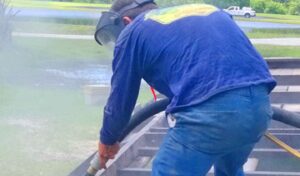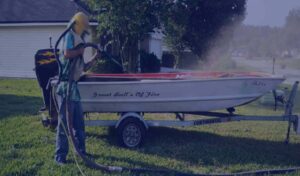
You pulled the aluminum housing off a boat motor, or the stainless rail off a UF-area restaurant patio, and it looks tired. Dull, stained, a little gray, maybe pitted at the edges. You do not want it gouged or etched. You want it to look clean and even, like it just left the shop. That is the job glass bead blasting was made for, and it is one of the most misunderstood finishes in the trade.
Here is the short answer. Glass bead blasting uses small round glass spheres to peen a surface instead of cutting it. It cleans, brightens, and leaves a soft satin finish without removing much metal. It is not a rust-and-heavy-coating tool. Below are six rules we follow in Alachua County, plus the honest times we will tell you to pick something else.
Rule 1: Know What Glass Bead Actually Does
Most abrasives are angular. Garnet and coal slag have sharp edges, and they chip and cut their way through rust and paint. Glass bead is different. Each piece is a tiny sphere, and when it hits metal it hammers the surface rather than slicing it. Trade people call that peening.
The result is a uniform, non-directional satin. No scratches running in one direction, no deep anchor profile, no bare steel gouged up for a coating to grab. It also work-hardens the surface slightly and closes up tiny surface pores, which is why cast parts and machined pieces come out so even.
So the first question is never “can you bead blast it.” It is “what do you want the surface to look like and do afterward.” If the answer is clean and satin, glass bead is in the running. If the answer is bare, rough, ready for heavy-duty primer, it is not.
Rule 2: Match Glass Bead to the Right Metal
Glass bead earns its keep on softer or finish-sensitive metals. Aluminum is the classic case. Aggressive media can warp thin aluminum panels and leave a rough, hazy surface that holds dirt. Beads clean oxidation and light staining while leaving the part dimensionally honest.
Stainless steel is the other big one. Heat tint, weld discoloration, and surface contamination come off cleanly, and the satin that is left is far more attractive than a ground or wire-brushed look. Brass, bronze, and cast pieces like pump housings and carburetor bodies also respond well.
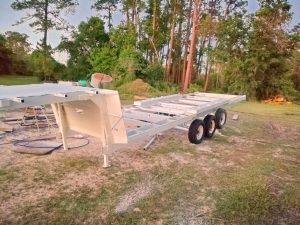
Plain carbon steel is where we slow down. A bead can clean light surface rust, but it will not cut through heavy scale or thick mill coatings in any reasonable time. If you have a rusted trailer frame or farm implement, that is a job for a cutting abrasive. Our metal sandblasting service in Gainesville page explains how we pick media for steel versus softer alloys.
Rule 3: Do Not Expect It to Strip Heavy Coatings
Here is the honest part most people skip. Glass bead is slow on thick paint, powder coat, and rust. It was never built for production stripping. Put it against three coats of enamel and you will burn an afternoon and a lot of media for a result a cutting abrasive would finish in a fraction of the time.
Where it shines is the final pass. Strip with a more aggressive media, then finish with beads for a refined look. Or use beads alone when the surface just needs cleaning: light oxidation, grease film, old sealer, fingerprints, tarnish, and dull factory finish.
If a wire brush and a little elbow grease will clear your problem, we will say so. We would rather lose a small job than sell you a method you do not need.
Rule 4: Pick the Bead Size for the Finish You Want
Glass bead comes in grades, and the grade changes the look. Finer beads leave a smooth, almost pearly satin that suits visible, decorative, or tight-tolerance parts. Coarser beads clean faster and leave a slightly more textured matte.
Pressure matters just as much. Thin aluminum sheet needs gentle pressure and a steady hand, or the surface will cup and ripple. A thick cast housing can take more. We test on a hidden spot first, show you the patch, and adjust before touching the part you care about.
That test patch is not a sales trick. Finish is subjective, and one person’s satin is another person’s too dull. Looking at a real sample in daylight settles it before the job starts, not after.
Rule 5: Florida Humidity Changes the Clock After Blasting
Clean, bright metal in North Central Florida does not stay that way. Bare steel starts to flash rust within hours in our humidity, and even stainless and aluminum pick up fingerprints and moisture spotting if they sit open. The air near the Santa Fe River and Paynes Prairie stays damp for much of the year, and a morning dew can undo a finish you paid for.
Plan the next step before the blasting starts. Parts that will be coated should be primed or sealed the same day. Parts that will stay bare, like decorative aluminum or stainless trim, should be wiped, bagged or sealed with a clear protective coat as soon as they are done. Mobile work helps here, because we blast at your site and the coating can follow right behind us. Our painting services in Gainesville are built for exactly that handoff, so the clean metal is never left sitting in weather.
Rule 6: Respect Dust, Contamination and Safety
Glass bead is considered a relatively clean abrasive, but any abrasive blasting throws fine dust, and the coating you remove may not be harmless. Older paint can contain lead, and fine particles of any kind are a breathing hazard. The federal guidance on this is plain, and the OSHA abrasive blasting resources are worth a read if you are weighing a do-it-yourself setup.
There is also a contamination point that bites hobbyists. If glass bead has been used on steel and then gets reused on aluminum or stainless, embedded iron particles can ride along and cause rust spots later. Clean, dedicated media for softer metals is not an upsell. It is how you keep a stainless finish from freckling with orange in a month.
When Glass Bead Is the Wrong Call
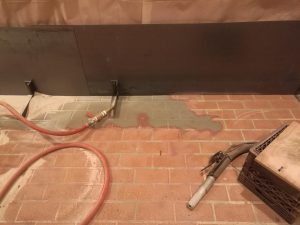
A few honest cases. Heavy rust on structural steel wants a cutting abrasive. Concrete, brick, and masonry need a very different approach, and for those you should look at our concrete sandblasting service or brick work instead. Thick, tough coatings like old epoxy and powder coat are better stripped with something aggressive first.
And if the part is a delicate, one-of-a-kind antique where any surface loss is a problem, we will talk it through before touching it. Sometimes the right answer is a gentler process or leaving the patina alone.
What to Bring to the Conversation
You do not need a spec sheet. Tell us the metal, the size, where it lives, and what you want it to look like afterward. Photos help. If you are not sure whether you have aluminum or plated steel, a magnet and a text message with a picture usually settle it. Bring any history you know, like whether the part was ever painted, coated, or exposed to salt.
From there we tell you straight which method your job wants, even when that is not the one with the most margin for us. For parts around Gainesville, Newberry, Alachua, and High Springs, the rig comes to you, which saves hauling pieces across the county.
The Bottom Line
Glass bead blasting is a finishing tool. It cleans and brightens softer and finish-sensitive metals, leaves an even satin, and keeps the part true to its shape. It is not a heavy stripper, and it is not a fix for deep rust. Used on the right job, with the right bead size and a fast follow-up coating, it is hard to beat for a clean look that lasts in Florida air.
Need sandblasting in Gainesville or nearby? Call (352) 663-1129 for a free on-site estimate. You will reach someone who actually does the work. You can also send us a message with photos.