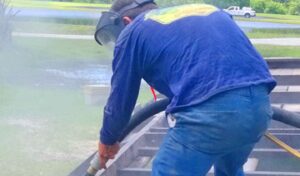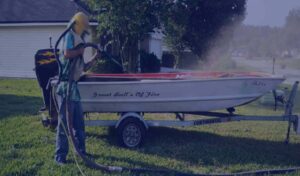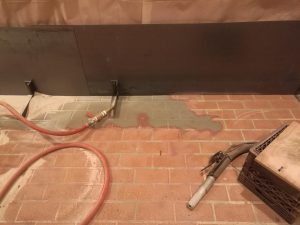
Someone found “vapor blasting” on a YouTube restoration channel, watched a filthy engine block come out looking like chrome, and called us asking if we do it in Gainesville. Fair question. Vapor blasting — also called wet blasting — is a real process, it does a few things beautifully, and it is not what most Alachua County jobs actually need. Here is the honest rundown: what it is, where it wins, and what we run instead.
What Vapor Blasting Actually Is
Vapor blasting injects a controlled stream of water into the abrasive right at the nozzle, so the media arrives at the surface riding inside a fine mist instead of dry. Some rigs call it wet blasting, some call it slurry blasting, and the marketing name changes depending on who is selling the machine. The mechanics are the same: water knocks down the dust cloud, cushions the impact of the media slightly, and carries a lot of the debris away as it goes.
That water jacket is the whole selling point. Dry blasting throws a cloud of dust and spent abrasive into the air. Vapor blasting mostly does not. For small parts — carburetors, cylinder heads, motorcycle frames, chrome trim — that difference is the reason restoration shops love it. You get a clean, satin, almost polished finish without the surface pitting a straight dry blast can leave on soft metal.
How It Stacks Up Against Dry Sandblasting
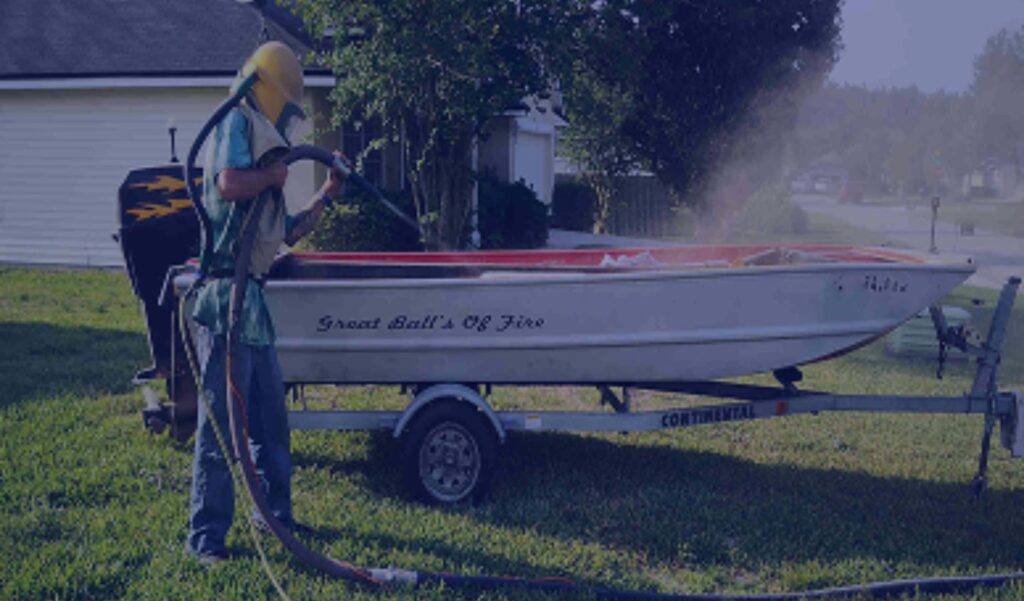
Dry sandblasting is faster, it is more aggressive, and it is the right call any time you are stripping rust or coating off something structural — steel gates, trailer frames, a stair rail, a piece of farm equipment. It also throws dust, which is why we contain the work site and why some jobs in Gainesville, especially ones close to a building or a neighbor’s fence line, call for a different approach.
Vapor blasting sits in between dry blasting and our own dustless process. It is gentler than dry media on thin or soft metal, and it leaves less mess in the air, but it trades speed for that gentleness. A job that takes an hour dry can take two or three wet. On a big surface — a whole fence, a concrete slab, a barn’s worth of metal roofing — that math stops making sense fast.
Where It Genuinely Wins
We will give vapor blasting its due. It shines on:
- Small engine and mechanical parts — blocks, heads, carburetors, transmission cases — where you want grease and carbon off without eating into tight tolerances.
- Chrome and polished trim — the water keeps the abrasive from dulling a finish that dry media would haze.
- Delicate castings — thin aluminum or pot metal that would warp or pit under a hard dry blast.
- Indoor or close-quarters work — a home garage, a shop bay, anywhere a dust cloud is simply not an option.
If that is your job — a swap-meet engine, a set of motorcycle cases, a box of small parts you want back looking new — vapor blasting is a legitimate, honest answer. We just are not the shop that runs that specific rig.
Where It Falls Short Around Gainesville
Here is the part most sellers skip. Vapor blasting leaves the surface wet, and wet bare steel in Florida does not wait around. Alachua County humidity being what it is, we have watched clean metal start showing a light orange bloom of flash rust inside an hour on a mild day, and faster than that in July. A vapor-blasted part that is not dried, primed, or oiled down immediately is a part rusting again before you have it off the bench.
It is also slow and expensive to scale up. Wet blasting a carburetor makes sense. Wet blasting a 40-foot fence, a concrete driveway, or the hull of a boat trailer does not — the water volume, the cleanup, and the time all balloon on anything bigger than a part you can carry. For structural steel, concrete, brick, or wood, dry abrasive or our own dustless method gets you further for less money and less risk of the metal rusting back before it is coated.
What We Actually Run in Gainesville
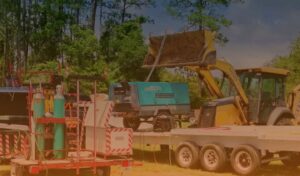
We do not operate a dedicated vapor-blasting rig. What we run instead is dustless blasting, which solves the same core problem — dust control — with abrasive and water combined in the blast pot rather than misted at the nozzle. It is built for full-size work: a gate, a driveway, a masonry wall, equipment sitting outdoors near a house or a business that cannot tolerate a dust cloud drifting over.
Here is the honest part most people skip when a salesman is trying to make dustless sound perfect: it leaves a wet, muddy mess behind that has to be cleaned up, and bare metal coming out of it needs to be dried and primed fast, the same flash-rust clock running as with vapor blasting. It is not magic. It is a genuine trade-off — less dust in the air in exchange for more cleanup on the ground — and depending on the site, that trade is exactly right or exactly wrong. We will tell you straight which one your job wants before we ever load the trailer.
For anything structural — rusted steel, an ornamental gate, a piece of equipment that has to hold a coating for years — our metal sandblasting service with dry media, matched to the piece and blasted to an SSPC standard, still does the heaviest lifting. Once the metal is clean and profiled, our painting and coating crew primes and coats it the same day, same crew, because bare steel sitting overnight in this climate is asking for trouble.
When You Should Not Bother Calling Anyone
If you have a single small part — a carburetor, a set of bicycle parts, a lawn tool bracket — and a friend with a bead-blast cabinet, use the friend. That is not a job that needs a service call, a trailer, or a vapor-blasting shop’s turnaround time. We would rather tell you that than take a job that does not need us.
Where we do earn our keep is the bigger, structural side of this: farm equipment, trailer frames, ornamental iron, industrial machinery, commercial steel, and anything where the coating has to hold up through a Florida summer without peeling back in a year. That is dry blasting or dustless work, done to a real standard, not a wet mist over a bench part.
The Standards Behind the Work
Whichever method a shop runs, the surface prep itself is not a matter of opinion. SSPC sets the commercial and near-white blast standards the coatings industry actually specifies, and OSHA publishes the safety requirements for anyone running abrasive equipment, wet or dry. You can read the prep standards at SSPC and the safety side at osha.gov/abrasive-blasting. We blast to the standard the job calls for and tell you which one it is, not the one that is cheapest to claim.
Questions We Get About Vapor Blasting in Gainesville
Can vapor blasting remove rust from a trailer frame or gate?
It can, technically, but it is the slow and expensive way to do it. A trailer frame or a section of ornamental fence has too much surface area for a wet-mist rig to make financial sense. Dry sandblasting or our dustless process clears the same rust in a fraction of the time, at a fraction of the cost, and gets primer on the steel before flash rust has a chance to start.
Does vapor blasting stop rust from coming back?
No process does that on its own — vapor blasting, dry blasting, dustless, it does not matter. What stops rust from coming back is priming the bare metal fast, before humidity gets to it, with a coating matched to what the piece will live through. The blasting method just gets you to clean steel. What happens in the next hour is what actually protects it.
Is vapor blasting safe to run near my house or business?
It is one of the quieter options on dust, which is exactly why restoration shops like it indoors. For full-size, outdoor work around a home or storefront in Gainesville, our dustless blasting does the same dust-control job at a scale that actually makes sense for a gate, a wall, or a driveway, and we still tarp and contain the site the way any responsible crew should.
The Short Answer
Vapor blasting is real, it is gentle, and it is the right tool for small parts and delicate finishes. It is the wrong tool for structural steel, concrete, brick, or anything sitting outdoors in Gainesville humidity that needs to be primed fast and coated to last. If your project is a part you can carry, look for a vapor-blasting specialist. If it is a gate, a trailer, a slab, or a piece of equipment that has to hold up, that is exactly the work we run every week around Alachua County — matched media, the right standard, and a crew that primes what it blasts before the metal has a chance to flash rust.
Need sandblasting in Gainesville or nearby? Call (352) 663-1129 for a free on-site estimate. You will reach someone who actually does the work.