
Every summer the same call comes in from Gainesville homeowners: the pool deck coating that looked sharp two seasons ago is peeling like a bad sunburn. Here is the honest part most people skip — the coating almost never fails because somebody bought cheap paint. It fails because the pool deck coating prep underneath it was rushed or skipped entirely. Prep is boring, dusty work, and it is the difference between a deck that lasts ten years and one you are redoing before the next Gator home game. Below are the seven steps we follow on pool decks and patio slabs across Alachua County — and, just as important, the situations where you should not hire us at all.

Why Pool Deck Coatings Fail So Fast in North Florida
A pool deck in Gainesville lives a hard life. Florida sun cooks it to well over 120°F by mid-afternoon, then a thunderstorm drops the surface temperature thirty degrees in ten minutes. That thermal shock works coatings loose at any weak spot. Add chlorinated splash-out from the pool, sprinkler water from an iron-heavy well, and the moisture that rises up through a slab sitting on our high water table, and you have a surface that punishes shortcuts.
The most common failure we see is not weather, though. It is a new coating rolled straight over an old sealer or a slick steel-troweled slab with no surface profile. The new product never bonds to the concrete — it bonds to whatever tired layer was already there. When that layer lets go, everything on top of it goes with it. That is why real pool deck coating prep starts with getting down to sound, clean, open concrete. No exceptions.
Pool Deck Coating Prep: The 7 Honest Steps
1. Walk the slab and map the damage
Before any equipment starts, walk every square foot. Tap suspect areas with a rod or even a golf club — a hollow sound means the old topping or coating has already separated. Circle the spalled spots, the cracks, and the flaking zones with chalk. In Alachua County we also look for rust stains tracking from sprinkler heads, because iron staining tells you where water sits. You cannot fix what you have not found, and finding it after the new coating is down costs a lot more.
2. Strip everything that is loose — and be honest about “everything”
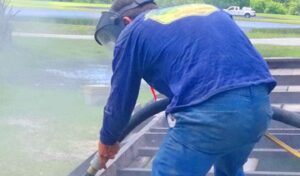
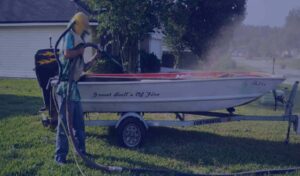
This is where most DIY jobs die. If 80% of the old coating is stuck tight and 20% is flaking, the temptation is to feather out the bad spots and coat over the rest. We will tell you straight: the new coating is only as strong as the oldest layer under it. Abrasive blasting takes the whole system off — acrylic sealers, cool-deck toppings, epoxy, paint — and gets you back to bare concrete in one pass. It is the same process we use for concrete sandblasting on driveways, patios and garage floors in Gainesville, tuned down with a finer media so we clean the surface without chewing it up.
3. Get the oil, sunscreen and old sealer off
Pool decks collect things a driveway never sees: sunscreen dripping off loungers, tanning oil, algaecide overspray, food grease from the grill. All of it is a bond-breaker. Blasting removes most contamination, but oily spots that have soaked in get degreased and rinsed separately. Skip this and you will watch the new coating fish-eye and peel in perfect circles right where the lounge chairs sat.
4. Open a profile the coating can grip
Coating manufacturers spec a surface profile — usually CSP 2–3 for pool deck products, which feels like 60-grit sandpaper under your palm. Most Florida decks were steel-troweled slick when they were poured, which is great for bare feet and terrible for adhesion. Blasting opens that dense cream layer so the coating keys in mechanically instead of just lying on top. This is the single step that separates a ten-year job from a two-year job.
5. Check moisture before anyone opens a bucket
Gainesville sits on a shallow water table, and low-lying lots — anywhere water stands after a summer storm — push moisture vapor up through the slab constantly. Tape a square of plastic sheeting to the clean deck and leave it overnight. Darkened concrete or droplets underneath in the morning means the slab is transmitting moisture, and you need a breathable coating or a moisture barrier primer. Rolling a non-breathable epoxy over a damp Florida slab is how you get blisters the size of pancakes.
6. Vacuum, rinse, and get the dust off
Blasting leaves fine dust in every pore you just opened, and dust is a bond-breaker just like oil. The deck gets vacuumed and rinsed, and the pool stays covered or gets skimmed after. It is unglamorous work. It also matters as much as any other step, because a coating gripping dust is gripping nothing.
7. Coat inside the weather window
June through September in Gainesville, the afternoon storm shows up around 3 p.m. like it has an appointment. Coatings go down in the morning, after the dew burns off and before the humidity spikes. Surface temperature matters too — product rolled onto a 130°F slab flashes off before it can level. We plan pool deck work around the radar, and when the window is not there, we wait. A rushed coat is a wasted coat.
When a Blast Rig Is the Wrong Tool
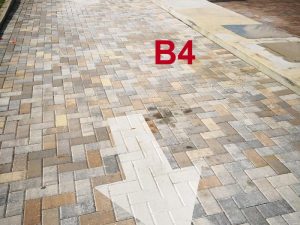
Some decks do not need us, and we would rather tell you that on the phone than take your money. If your coating is sound and you just want a color change, a good cleaning and a scuff may be all the prep required. If the deck is bare concrete that has never been coated and it is simply dirty or green with algae, a pressure wash is the right call, not blasting. If you have a paver deck, do not blast it at all — re-sand the joints and reseal. And a single hairline crack needs a polyurethane caulk and a Saturday morning, not a mobile blast rig. If a wire brush and a weekend will do, we will tell you.
Blasting Beside a Pool: The Trade-Offs Nobody Mentions
Blasting next to an open pool and a screen enclosure takes planning. Dry blasting is fast and leaves a surface ready to coat the same day, but it makes dust, so we contain the work area and keep media out of the water. Wet dustless blasting in Gainesville knocks the dust down dramatically — a real advantage tight against a lanai — but it trades dust for slurry that has to be managed and a damp slab that needs to dry before coating. Neither is “better.” We pick by the job site, never the invoice. Either way, silica exposure is a real hazard on concrete work, and we follow OSHA’s abrasive blasting protective measures on every residential job, not just the industrial ones.
One Crew From Blast to Final Coat
Here is the practical reason prep and coating should be the same company: when the crew that blasted the deck is the crew rolling the coating, nobody can point fingers about whose prep failed. We handle the stripping, the profile, and the coating and painting work in Gainesville with the same people, often finishing the prep in the morning and priming before the afternoon storm builds. The rig comes to you — Newberry, Jonesville, Haile, Alachua, anywhere in Alachua County. Licensed and insured, and the number you approve is the number on the invoice.
After the Coating: Making It Last in Alachua County
Good prep buys you years, but a little upkeep buys you more. Rinse chlorinated splash-out off the deck every week or two — pool water sitting on any coating shortens its life. Aim sprinkler heads away from the slab; that rusty well water striping your deck orange is also soaking the coating edges. Set furniture feet on pads so the legs do not grind through the finish, and recoat high-traffic lanes when they start to dull instead of waiting for bare concrete to show. A maintenance coat over a sound, well-prepped surface is a light job. A full redo after the system fails is not. That is the whole argument for doing the pool deck coating prep right the first time.
A pool deck is the hardest-working slab on your property. Prep it like it matters, and the coating will outlast the furniture sitting on it.
Need sandblasting in Gainesville or nearby? Call (352) 663-1129 for a free on-site estimate. You will reach someone who actually does the work.