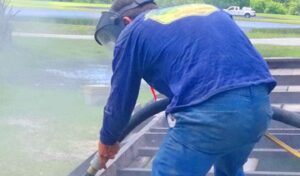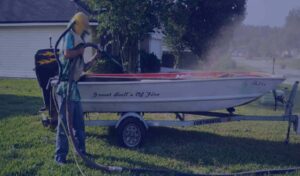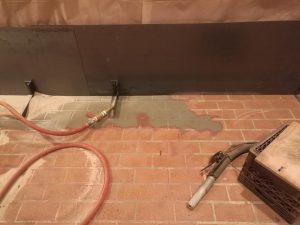

Six months after a good blast job, bare steel should still look like steel. When it does not, the blasting was rarely the problem. The rust prevention coatings were. Around Gainesville, FL we see it constantly: somebody strips a trailer frame or a set of stair stringers down to clean metal, brushes on whatever was cheapest on the hardware store shelf, and by the second rainy season it is bubbling along every weld. Alachua County humidity does not forgive a thin coating system, and no amount of good blasting will save one.

So here is the honest part most people skip. Blasting does not protect anything. Blasting buys you a window — a few clean hours of bare, profiled steel — and what you put into that window decides whether the job lasts two years or twenty.
Why Florida Humidity Is Brutal on Rust Prevention Coatings
Steel rusts when water and oxygen reach iron. That is the whole story. Everything a coating does is about keeping those two apart, and Central Florida makes that hard in three separate ways.
The dew point. Most mornings from May through October, our air sits close enough to saturated that steel left outside is physically wet by sunrise. Paint applied over damp metal does not bond to the metal. It bonds to a film of water, and eighteen months later it comes off in sheets that look like sunburned skin.
The swing. A metal gate in Newberry can go from 68 degrees at dawn to 140 degrees in afternoon sun. Coatings expand and contract with that. Cheap single-part paint gets brittle and cracks at the edges and welds first — which is exactly where rust wants to start anyway.
Soluble salts. If the piece ever sat near the coast, hauled fertilizer, or lived behind a barn where livestock splashed the frame, there are chlorides on that steel. You cannot see them. Blasting alone does not always remove them. Salts left under a coating pull moisture straight through the film and rust the steel from underneath while the paint still looks fine. That is why a job can fail with a perfect-looking finish sitting on top of it.
6 Rust Prevention Coatings That Actually Hold Up Here
1. Zinc-rich primer — the heavyweight
Zinc-rich primer is the closest thing to insurance in this trade. It works galvanically: the zinc corrodes instead of the steel, so even if the film gets scratched down to metal, the surrounding zinc keeps protecting that spot. This is what belongs on structural steel, gooseneck trailers, ornamental gates, and anything living near water. It is also the fussiest of the bunch — it wants a genuine near-white blast and a real anchor profile, not a wire-brushed surface and hope.
2. Two-part epoxy primer — the workhorse
For most of what rolls into a Gainesville shop, a two-part epoxy primer is the right answer. It cures by chemical reaction rather than by evaporation, so it builds a genuinely tough, moisture-resistant film that bites into a blasted profile. It is what we reach for on equipment frames, implements, railings, and fabricated steel. Epoxy has one weakness worth naming out loud: sunlight. It chalks. Which is exactly why it needs a topcoat.
3. Epoxy mastic — when you cannot reach bare metal
Sometimes you cannot blast every square inch. Think of a tight barn-aisle bracket, or a hollow section where the nozzle simply will not reach. Surface-tolerant epoxy mastic is built for that compromise. It is thicker, it wets out over tightly adhered rust, and it buys real years. It is not as good as blasting to bare metal. We will tell you that up front rather than pretend the shortcut is equal to the real thing.
4. Polyurethane topcoat — the sunscreen
A polyurethane topcoat over epoxy primer is the standard two-coat system for anything that lives outdoors in Florida. The epoxy handles corrosion, the urethane handles UV and abrasion and keeps the color from fading into a dusty version of itself. On a gate or a trailer that somebody actually looks at, this is the combination worth paying for.
5. Direct-to-metal acrylic — useful, with honest limits
DTM acrylics are fast, low-odor, and fine for interior steel, shop shelving, handrails under a covered walkway, or a fence panel you plan to repaint in a few years anyway. They are not the answer for a boat trailer that gets dunked, or for structural steel you want to forget about for a decade. Anyone selling you DTM for a marine trailer is selling you a repeat job.
6. Cold galvanizing compound — for repairs, not whole projects
Cold galvanizing in a can is genuinely good at what it is for: touching up a weld, a drilled hole, or a scratch on hot-dip galvanized steel. It is not a coating system for a full frame. If someone quotes a whole trailer in aerosol zinc, keep looking.
The Window: Why We Prime Before Supper
Freshly blasted steel in Alachua County starts flash rusting in hours — sometimes under two on a humid August afternoon. That faint orange bloom is thin, but it is a contaminant, and priming over it locks a failure into the job on day one.
This is the single biggest reason we do our own coating. When the same crew blasts and coats, primer goes on inside the window, on the same visit, while the profile is still clean and dry. When blasting and painting are two different companies on two different days, that window closes overnight and nobody owns the gap. Our metal sandblasting in Gainesville and our protective painting and coating services are deliberately the same crew on the same day for exactly that reason.
The other half of the window is profile. Coatings need texture to grip — a measurable anchor pattern, not a polished shine. The standards for how clean and how rough that surface should be come from SSPC, now part of AMPP; their published surface preparation standards are what a real spec references. If your job calls for the enclosed, low-dust approach instead, dustless blasting in Gainesville reaches the same profile with far less airborne grit — though wet methods start their own flash-rust clock, and we will say so before we start.
5 Mistakes That Kill Good Rust Prevention Coatings
- Painting over flash rust. If the steel bloomed orange while you went to lunch, it needs a quick re-sweep before primer. Every time.
- Ignoring the dew point. Coating in the hour after a Florida afternoon storm is throwing money at a wall. The steel is wet even when it looks dry.
- Skipping the topcoat. Bare epoxy in full sun chalks within a season. It still protects, but it looks abandoned.
- Thin film build. One stingy pass is not a system. These coatings work by thickness as much as by chemistry, and edges and welds always end up thinnest.
- Sealing in salt. On anything that has lived near saltwater or fertilizer, the surface should be washed and tested before coating, not just blasted and painted.
Blasting also throws real dust, and on older coatings, potentially hazardous material. That is not a scare tactic, it is why the crew wears what it wears; OSHA lays out the exposure rules in its abrasive blasting guidance. If a bidder is blasting a 1970s farm gate in a t-shirt and no respirator, that tells you something about how carefully he handles the parts you cannot see either.
When You Do Not Need a Blaster at All
Plenty of jobs do not justify a rig in your driveway. A porch railing with three rust spots and sound paint everywhere else? Sand the spots, spot-prime, topcoat, and get your Saturday back. A shop shelf? A rattle can of DTM is fine and nobody will ever know the difference.
Call somebody like us when the rust is structural, when the old coating is failing across the whole piece, when the steel matters — a trailer frame, a stair stringer, a gate you paid a fabricator good money for — or when you want a coating system that outlives the truck you hauled it in on. If a wire brush and an afternoon will genuinely do it, we will tell you that on the phone and save us both the trip.
Need sandblasting in Gainesville or nearby? Call (352) 663-1129 for a free on-site estimate. You will reach someone who actually does the work.