Log cabin sandblasting in Florida is not a niche curiosity — it is usually the only realistic way to bring a weathered log home back. If your cabin or log house has darkened, grayed, or grown a patchwork of failing stain, you have probably already discovered the problem: every method you research either takes forever, soaks chemicals into your logs, or threatens to chew up the wood itself. This guide explains why Florida is uniquely hard on log homes, what happens when restoration is delayed, why chemical stripping disappoints, how controlled sandblasting actually restores log walls, and what a professional job looks like from estimate to final stain.
Why Florida Is So Hard on Log Homes
Log homes were perfected in cold, dry climates. Florida is neither. Our humidity keeps wood moisture content high year-round, which feeds mildew, algae, and the slow breakdown of finishes. Summer UV is brutal on south- and west-facing walls — it destroys the resins in stain, which is why those walls gray and flake years before the shaded sides. Daily storms drive water into the checking cracks every log develops, and warm temperatures accelerate every one of those processes. The practical result: a stain job that lasts a decade in Tennessee lasts five to seven years here, and a cabin that goes unmaintained for fifteen falls badly behind. None of this means log homes do not belong in Florida — it means their finish schedule matters more, and their restoration, when it comes due, has to be done properly.
What Happens Without Restoration
An aging finish does not just look tired — it stops doing its job. Once stain fails, logs absorb and release moisture with every storm and dry spell, and that cycling opens the surface: deeper checking, raised grain, gray oxidized wood, and a foothold for mildew. Soft spots follow where water sits — lower courses, corners, anywhere splash-back reaches. Re-staining over this without stripping locks the damage in and the new coat fails fast, because stain needs to penetrate wood, not sit on dead finish. Caught reasonably early, all of this is recoverable; the gray oxidized layer is thin, and clean wood is right underneath it waiting.
Why Chemical Stripping Disappoints on Log Homes
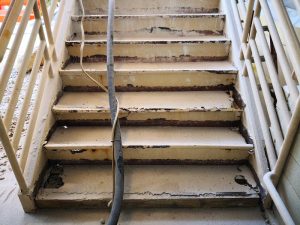
Strippers have their place on furniture and trim. On a whole log structure they run into physics. Round, contoured logs do not hold a chemical evenly — it runs, pools in checks, and works unevenly, leaving tiger-striped walls. The chemicals soak into old, dry wood and the checking cracks, where they linger and can interfere with the new stain you are trying to help. The volume is enormous — a modest cabin is hundreds of square feet of textured surface per wall — so the labor of applying, dwelling, scrubbing, neutralizing, and rinsing multiplies fast. And after all of it, the gray oxidized layer often remains, because chemicals dissolve finish, not weathered wood. Pressure washing as a finisher just drives water deep into logs that then need weeks to dry. Most owners who start with chemicals on a log home finish the project a different way.
How Sandblasting Restores a Log Cabin
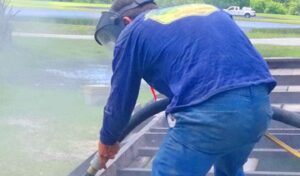
Controlled abrasive blasting solves each of those problems mechanically. The abrasive — often a gentler media such as crushed glass, or organic media like walnut shell or corn cob for delicate work — removes the failed finish AND the thin gray oxidized layer together, following the contour of every log, reaching into checks and corners, and leaving uniform, clean, natural wood. Pressure and media are matched to the timber so the grain is preserved rather than chewed: done right, blasting raises the grain slightly, which most log-home owners consider the proper, natural look. The whole exterior of a typical cabin takes days, not the weeks or months of hand methods — and the result is wood that fresh stain can actually penetrate. This is the heart of our wood sandblasting service, and for cabins near neighbors or with landscaping tight to the walls, our dustless blasting option keeps the dust down while it works.
What to Expect From a Professional Job
A proper log home restoration follows a sequence. It starts with an on-site assessment: finish type, wood species and condition, soft spots, and what the owner wants the finished walls to look like — followed by a written quote. On the job, windows, trim, rooflines, and landscaping are masked and protected. Blasting proceeds wall by wall, with media and pressure adjusted as conditions change — sun-baked south walls behave differently than shaded north ones. A test patch on an inconspicuous area sets expectations before the full job. Spent media is collected as work progresses, and each wall is inspected before moving on. Then the most important scheduling detail in Florida: fresh-blasted logs should be stained promptly, before humidity and UV start working on the bare wood — a few good drying days, then stain, in one planned sequence rather than an open-ended gap.
A Real Florida Log Cabin Project
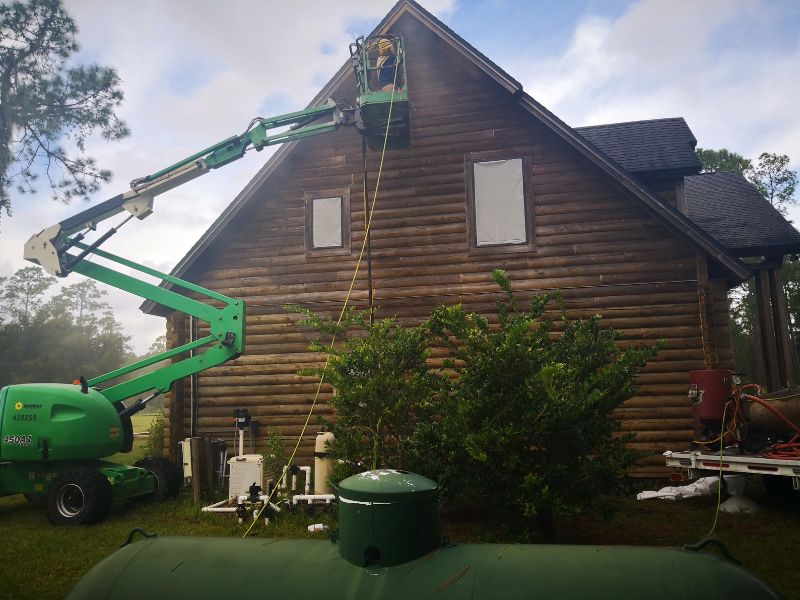
We restored a North Central Florida log cabin exactly this way: decades of old stain and weathered surface removed from every exterior face, contoured logs stripped uniformly without gouging, and the natural grain brought back ready for fresh protective stain. You can see the photos and the full process in our log cabin restoration case study — it is the clearest before-and-after argument for why blasting is the method log homes need.
Log Cabin Restoration FAQs
Will blasting damage the chinking between logs? We work around sound chinking and adjust technique near joints; failing chinking is usually replaced after blasting anyway, which is the correct order.
How soon after blasting must the cabin be stained? Promptly — ideally within days, weather allowing. Bare wood left exposed in Florida begins graying and absorbing moisture again quickly.
Can one wall be done instead of the whole cabin? Yes, though color matching a single restored wall to aged neighbors takes planning; many owners stage the work by elevation.
What does it cost? It scales with wall area, finish condition, and access — see our cost guide for typical local ranges, and get an exact figure from a free on-site estimate.
Staining After Blasting: Doing It Right
The stain step deserves as much care as the strip. Freshly blasted logs drink stain — that is the point — so use a penetrating, breathable product made for log homes rather than a film-forming deck paint that will peel as the logs move. Back-brush every coat so the stain works into the raised grain and the checks instead of bridging over them, and hit the end grain and lower courses hardest, because that is where Florida water gets in. Two thinner coats beat one heavy one. If you would rather hand the whole sequence to one crew, we apply stain and protective finishes through our painting and coating services right after blasting, so the bare-wood window stays short.
A Realistic Maintenance Schedule for Florida Log Homes
After restoration, protect the investment with a simple rhythm. Walk the cabin every spring: look for graying on the sun-baked walls, dark mildew streaks in the shade, and any checks that have opened enough to hold water. Rinse the walls gently once or twice a year to keep mildew food off the finish. Expect to refresh the sun-facing elevations a year or two before the rest — staggering coats by elevation is normal here, not a failure. Most Florida log homes want a maintenance coat roughly every three to five years depending on exposure, which is far cheaper than another full strip. Do that, and the blasting you just paid for becomes a once-in-decades event instead of a recurring one.
Buying or Selling a Log Home in Florida?
Restoration timing often collides with a sale. For sellers, a cabin with gray, flaking walls photographs poorly and invites inspection questions about rot that clean, freshly stained logs simply do not raise — restoration before listing routinely pays for itself in both price and speed of sale. For buyers, a weathered exterior is a negotiating point, not a dealbreaker: the gray layer is thin, sound logs underneath are common, and a blasting and staining quote turns an unknown into a fixed number you can take to the table. Either way, get the assessment before the appraisal. We walk Florida log homes regularly, and we will tell you plainly which walls need full restoration, which only need a maintenance coat, and whether anything we see suggests deeper repair work that belongs to a carpenter rather than a blasting crew. That kind of clarity costs nothing and keeps a log home transaction from stalling over the one thing log homes show most: their finish.
Need sandblasting in Gainesville or nearby? Call 352-663-1129 for a free on-site estimate.